

- Compliance & Regulation, Fraud, Risk
Community Bank Takeaways from ProSight’s 2026 State of Fraud Prevention Survey
- A look at the 2026 ProSight fraud survey through the lens of smaller banks.
Banks of all sizes agree on one thing: fraud is evolving faster than most financial institutions can keep pace with it. In ProSight’s 2026 State of Fraud Prevention Survey, 86% of institutions, from credit unions and community banks to the nation’s largest institutions, said fraudsters currently have the upper hand in the use of AI for fraud and fraud prevention. For institutions with less than $10 billion in assets, the landscape looks even more challenging: 92% said fraudsters are ahead, with 51% saying they are substantially ahead.
That’s not resignation—it’s recognition. Banks of all sizes are responding with new tools, training, and ways of working together. Community banks are part of that effort, albeit with fewer resources than their largest peers.
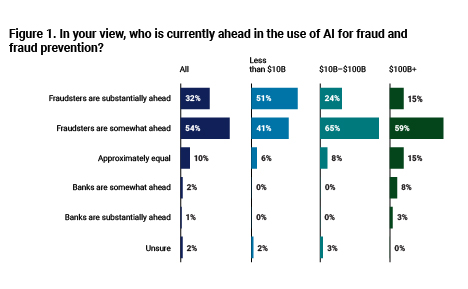
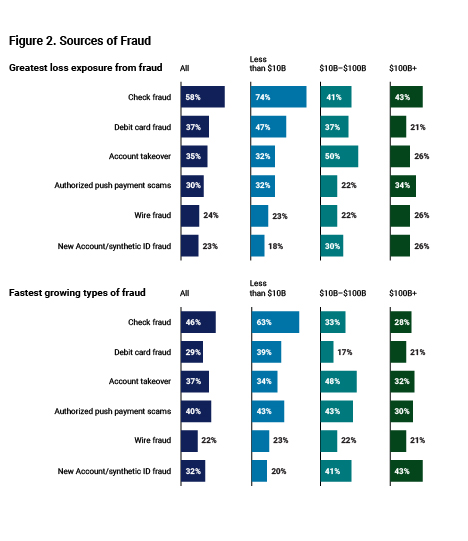
Banks with assets of $10 billion or less are confronting longstanding schemes and brand new ones at the same time. While scammers deploy AI-generated deepfakes and synthetic identities, community banks are still absorbing losses from decidedly analog fraud: check fraud remains their single biggest loss exposure, cited by 74% as a top current threat, with debit card fraud a close second at 47%. They’re also contending with newer risks like mule fraud, cited by 22%, and AI tools reshaping the threat landscape.
When Mythos Got Everyone’s Attention
Advanced AI tools capable of finding software vulnerabilities—Anthropic’s Mythos being a prime example—leapt onto bank agendas just before the survey was fielded over the summer. Two-thirds of institutions, including a majority in every size tier, said Mythos-class tools had already prompted discussions about stepping up defenses.
“We recognize that advanced AI tools present emerging risks to identity verification, authentication systems, and cybersecurity defenses,” wrote a credit union CEO. “We remain focused on strengthening layered security controls, enhancing monitoring capabilities, educating members and employees, and working with industry partners to address evolving threats.”
A senior risk executive at a community bank put the economics bluntly: “Fraudsters do not need to comply with AI or model governance rules. They do not care if they have a 98% fail rate—2% is easy money, and the AI tools are cheap.”
Leaning on Outside Help
For most community banks, keeping pace with tools like Mythos means leaning heavily on outside partners. Forty-five percent call third-party vendors and technology providers “critical” to their fraud strategy, three times the share among the largest banks. Overall, 86% of under $10 billion institutions rate vendors as important or critical, compared with 59% of the largest banks.
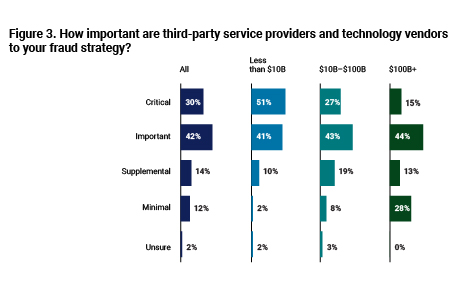
In practice, that means putting vendor tools to work. A credit union risk manager described evaluating rules through card-monitoring vendor software to catch debit card fraud, while a community bank fraud executive said progress comes down to reviewing security vendors’ success at catching fraud earlier in the process.
Investing Where It Counts
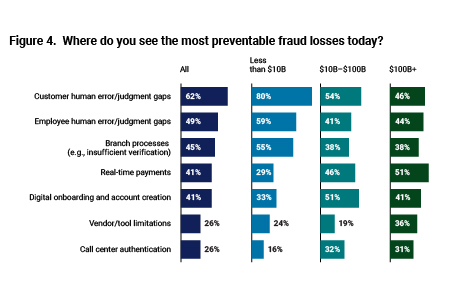
Community banks are emphasizing people, not just technology. Asked where they see the most preventable fraud losses today, 80% of community banks pointed to customer human error or judgment gaps and 59% cited employee error. That shows up in what they’re already doing: 82% have added employee training and 88% have stepped up customer communications as proactive measures. Looking over the next three years, customer education is a near-universal priority for under $10 billion institutions: 88% plan to increase it.
Whitney Darcy, senior vice president, BSA and fraud operations manager at Fidelity Bank NA, a $3 billion institution based in Wichita, Kansas, has put that philosophy into practice. Her team created a wallet card printed with fraud red flags for customers. Keeping it handy means that “if a situation seems weird, you’re not trying to dig for a website or pull out a booklet.”
For staff, she uses short videos she calls “drip content.” As she explains: “I can get a banker to watch a five-minute video on our intranet about a scam and how to spot the red flags when that customer is standing in front of them.”
Strength in Numbers
Banks of every size agree that collaboration matters. Ninety-three percent of community banks said they were “very” or “somewhat” interested in greater industrywide fraud collaboration.
Darcy has turned her interest into infrastructure. She founded the Metro Area Fraud Investigators Association in Wichita, a peer network of 22 financial institutions, 12 law enforcement agencies, and more than 75 people sharing real-time fraud alerts by email. “We’ve been able to prevent losses at other institutions,” she said. Through the International Association of Financial Crime Investigators, she can also reach contacts directly when a suspicious wire needs to be flagged quickly.
A BSA/AML officer at another community bank described a similar payoff, sharing information about known fraud perpetrators “openly and freely with other financial institutions and local enforcement.” That practice, the officer said, “has helped my community and network of financial institutions stop fraud in its tracks.”
Not every institution has the resources to build that kind of program. One community bank risk executive noted that fraud teams are often “small, if they exist,” making it difficult to produce education “in multiple forms” while handling day-to-day fraud response. “The best resource today,” the executive said, “is finding trusted sources who already have information that is digitally and graphically appealing that can be shared.”
For additional fraud intelligence, best practices, and customer education resources, learn more about the ProSight Fraud Alert Network.